

Blog
How to Choose Cue Weight for Better Play

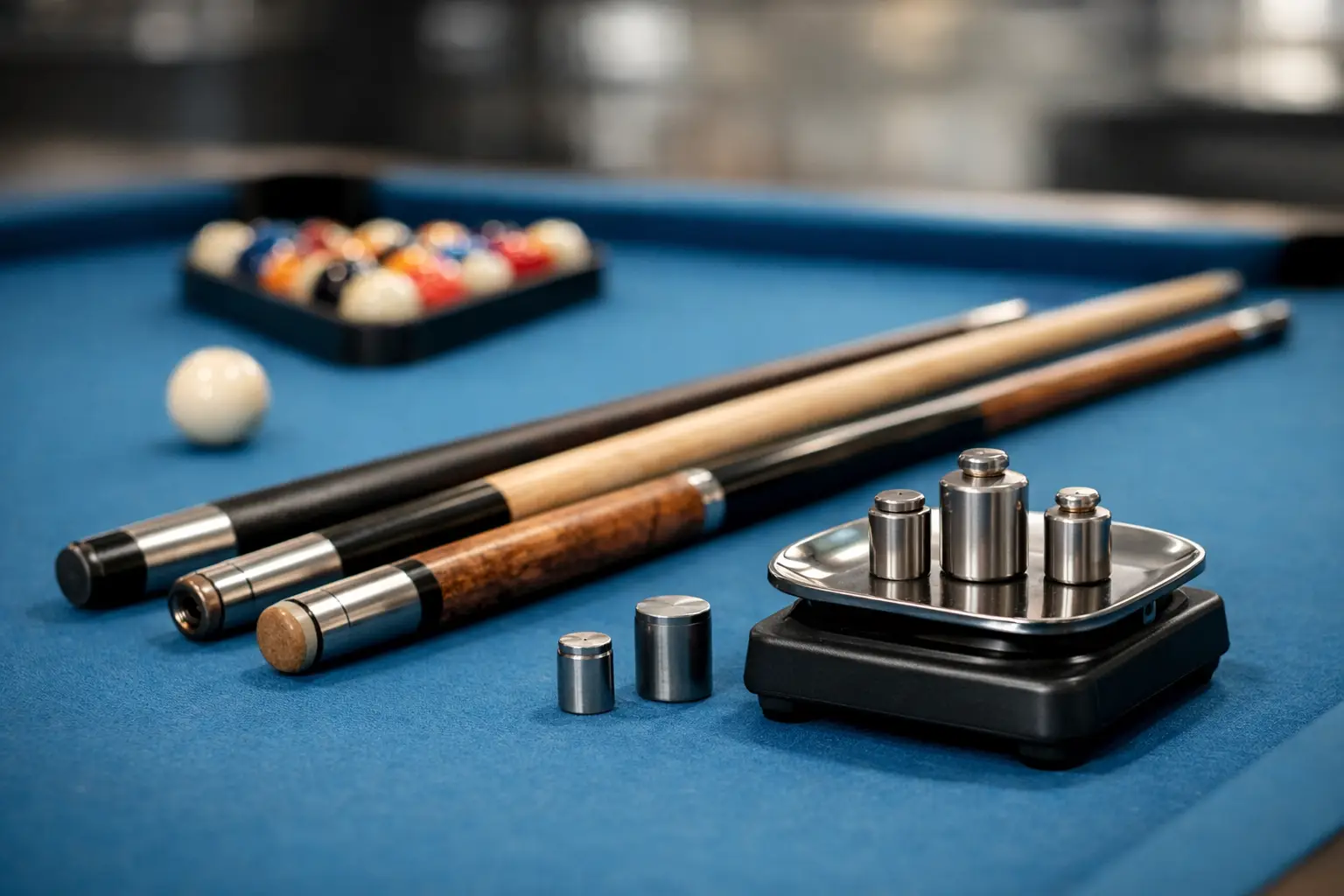
Miss a ball by a hair, overrun shape by six inches, and suddenly your cue starts feeling either too heavy or too twitchy. That is usually where players begin asking how to choose cue weight – not as a theory question, but because their current setup is costing them control, speed, and confidence.
Cue weight is not a magic number. It is a performance setting. The right weight helps your stroke stay on line, keeps your timing clean, and makes speed control feel repeatable instead of random. The wrong weight can force compensation into every shot. For serious players, that is dead weight.
How to choose cue weight without guessing
Most playing cues land between 18 and 21 ounces, with 19 ounces sitting in the middle for a reason. It works for a lot of players because it balances control and natural cue ball speed. But average does not mean ideal. If your stroke is compact and quick, 19 may feel perfect. If you have a longer stroke with more acceleration, that same cue can start to feel slow through the ball.
The real goal is not to chase what pros use or what your friend swears by. It is to find the weight that matches your delivery. Cue weight should support your mechanics, not fight them.
A lighter cue, usually around 18 to 18.5 ounces, tends to feel faster and more responsive. Many players like that because it makes finesse shots, spin work, and quick cue acceleration feel easier. The trade-off is that lighter cues can also expose stroke flaws. If your timing is inconsistent or your back hand gets jumpy under pressure, a very light cue may feel brilliant one rack and loose the next.
A heavier cue, usually 19.5 to 21 ounces, often feels more stable. Some players love the planted, solid sensation, especially on stop shots, firm follow shots, and pressure situations where they want the cue to calm the stroke down. The trade-off is reduced touch for some players. Too much weight can make soft-speed control feel clumsy and can encourage steering instead of releasing the cue naturally.
Start with your stroke, not your ego
If you want the clean answer to how to choose cue weight, start by looking at how you actually move the cue.
Players with a smooth, relaxed, straight stroke can usually handle a wider range of cue weights. Their mechanics are doing the heavy lifting. Players with a punchier delivery or a shorter backswing often benefit from testing lighter options first, because they can generate speed without dragging extra mass through the shot.
If your stroke slows down by impact, a heavier cue may be part of the problem. If your cue feels unstable on longer shots or under pressure, adding a little weight may help settle everything down. Neither fix is universal. That is why cue weight should be treated like tuning, not branding.
Your bridge length matters too. A longer bridge can make a cue feel lighter and more whippy in motion. A shorter bridge can make the same cue feel denser and more compact. Two players can hit the same cue and report completely different impressions because their setups are different.
The biggest mistake players make
Too many players choose cue weight based on power. They assume heavier means stronger. In real play, power comes from timing, clean contact, and efficient energy transfer. If the cue is too heavy for your natural rhythm, you may actually lose speed because the stroke gets tighter.
The same goes for spin. A lighter cue does not automatically create more action. It may simply let you accelerate more freely. That helps only if you can stay accurate through contact. More movement without control is not performance. It is noise.
That is why the best cue weight is usually the one that disappears. You stop thinking about the cue and start trusting the shot.
How to test cue weight the right way
Do not judge cue weight from three warm-up strokes and a few hard hits. That tells you almost nothing. Test with real shot categories.
Start with soft stun shots from short range. If the cue feels hard to regulate at low speed, it may be too heavy. Then hit a set of longer draw shots. If the cue struggles to get through the cue ball without extra effort, it may be too heavy for your stroke or too slow in balance. After that, test medium-speed position shots where cue ball control matters more than raw force. That is usually where the truth shows up.
Pay attention to one question above all others: does the cue help you deliver the same stroke over and over? Not the biggest stroke. The same stroke.
You should also test under fatigue. A cue that feels great for ten minutes can start feeling demanding after an hour. If your game includes long sessions, league nights, or tournaments, endurance matters. A cue weight that stays efficient deep into play is worth more than one that feels explosive for five racks.
Cue weight and balance are not the same thing
This is where many players get crossed up. Total cue weight matters, but balance point can change the entire experience.
A 19-ounce cue with more forward balance can feel heavier during the stroke than a 19.5-ounce cue with a more neutral or rear balance. Forward-balanced cues often feel more deliberate and stable through the front of the shot. Rear-balanced cues can feel quicker and easier to maneuver.
That means if your cue feels wrong, the issue may not be the number on the scale. It may be where the mass sits. Serious equipment should let you fine-tune that relationship. Adjustable weight systems exist for a reason. Precision players need more than one locked-in setting.
This is exactly why advanced cue design has moved beyond simple ounce labels. Performance-driven players want customization, not guesswork. ON CYBORG leans into that mindset because modern cues should adapt to the player, not the other way around.
What most players should actually choose
If you are buying blind and need a smart starting point, 19 ounces is still the safest launch setting for most pool players. It is balanced enough for touch, solid enough for confidence, and neutral enough to reveal what you really want after a few sessions.
If you already know you prefer a fast, lively feel and rely on cue speed more than cue mass, move toward 18.5 ounces. If you value a more grounded stroke and want the cue to feel substantial in your hand, test 19.5 ounces.
Going all the way to 20.5 or 21 ounces makes sense for some players, but not because it sounds powerful. It should be a specific fit for your tempo, shot selection, and feel preference. The same caution applies on the light end. Very light cues can feel electric, but only if your mechanics are clean enough to cash in on that speed.
Pool, carom, and break cues change the answer
If you play multiple disciplines, your preferred cue weight may shift.
For pool play, the sweet spot often stays in the middle because the game demands both touch and controlled power. For carom, where precision, spin, and refined cue ball paths are everything, some players become more sensitive to small differences in weight and balance. For break cues, the conversation changes again. There, efficient transfer of force matters more than delicate speed control, so some players prefer a different weight than they use for their playing cue.
Do not force one weight philosophy across every cue in your case. A playing cue, break cue, and jump cue all have different jobs. Elite setups reflect that.
Signs your cue weight is wrong
If you regularly decelerate into the ball, struggle to control soft speed, or feel arm fatigue earlier than you should, your cue weight deserves scrutiny. If you overhit position shots, feel rushed in your transition, or cannot settle into a repeatable tempo, the cue may be too light or too fast in balance for your current stroke.
The answer is not always dramatic. Sometimes half an ounce is enough to change the entire feedback loop. At this level, small adjustments are not cosmetic. They are competitive.
The best players do not treat equipment as decoration. They treat it as calibrated hardware. If you are serious about your game, that is the lens to use when deciding how to choose cue weight. Pick the setup that lets your stroke fire clean, your timing stay sharp, and your cue ball obey without negotiation. When the cue starts feeling like an extension instead of an object, you are close.