

Blog
Cue Balance Point Guide for Better Cue Control

A cue can look perfect on paper and still feel wrong the second it gets into your bridge hand. That usually comes down to one thing this cue balance point guide is built to fix – understanding where the cue carries its weight, how that changes your stroke, and what kind of balance actually helps you play better.
Most players talk about tip hardness, shaft diameter, or total cue weight first. Those matter. But balance point is where the cue starts telling the truth. It affects how heavy the front end feels during delivery, how stable the cue stays on long shots, and whether your stroke feels smooth or like you are dragging the cue through the line.
What cue balance point really means
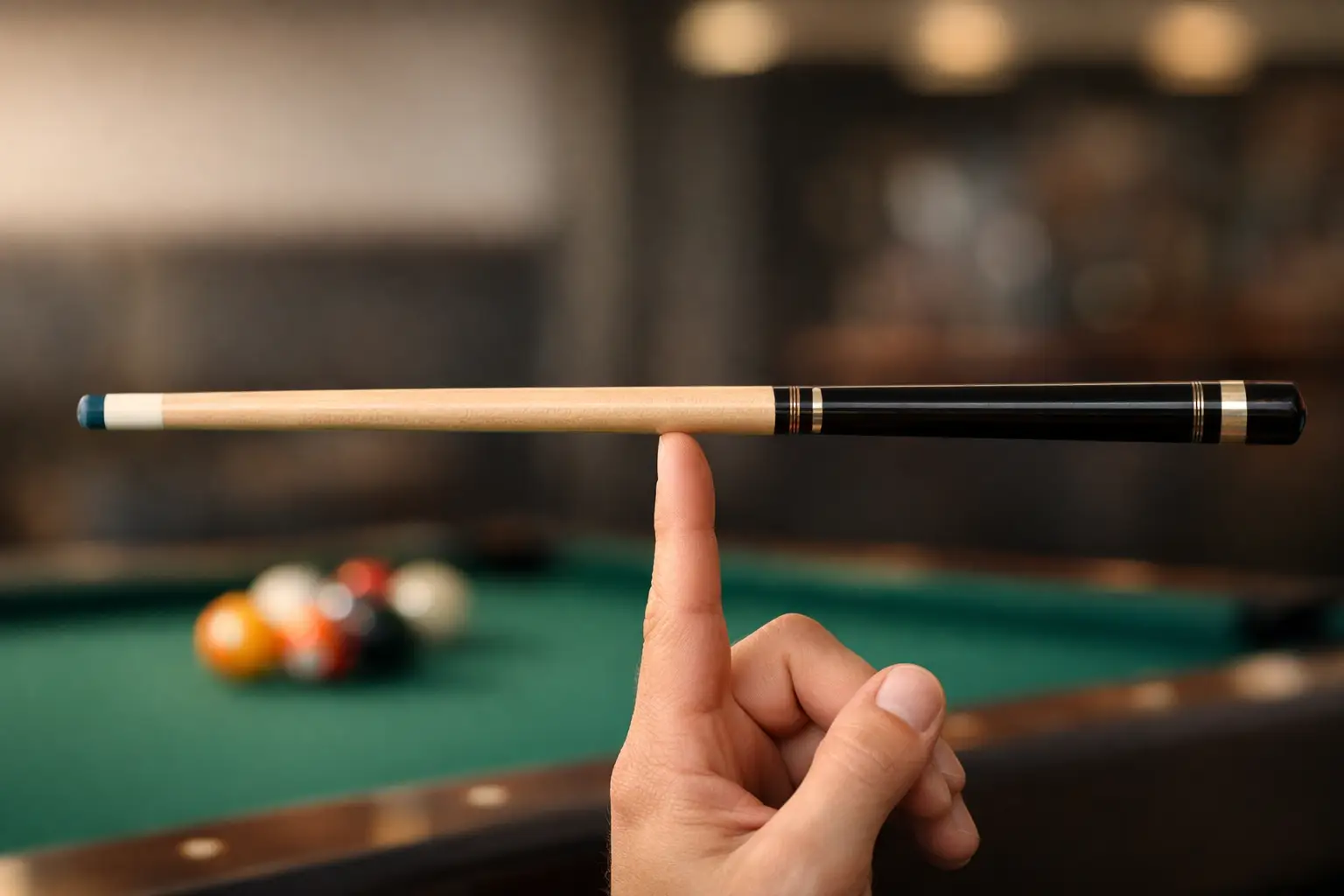
The balance point is the spot where the cue rests evenly on a single support. Put simply, it is the point where the cue neither tips forward nor backward. Measured from the bumper end, this tells you whether the cue is more forward-balanced, rear-balanced, or close to neutral.
That sounds basic, but the effect is not. Two cues can both weigh 19 ounces and play completely differently if one carries more mass toward the shaft and the other loads it toward the butt. Same total weight, different fight in your hands.
A forward-balanced cue usually feels more planted through the shot. Many players describe it as smoother on follow-through and more natural for rolling the cue ball with less effort. A rear-balanced cue can feel faster to move, easier to accelerate, and more lively for players with a compact stroke. Neutral balance tends to sit in the middle – less dramatic, more adaptable.
Cue balance point guide: what different balances do
There is no universal best balance point. There is only the best balance for your stroke, your game, and the shots you face most.
Forward-balanced cues
A forward-balanced cue places more of the working feel closer to the shaft end. This can make the cue seem steadier during the final delivery. If you like a long, flowing stroke and want the cue to stay on line without feeling twitchy, this setup often makes sense.
The trade-off is speed of movement. Some players feel a stronger front end makes quick touch shots or wrist-driven adjustments less natural. If your stroke is compact and snappy, too much forward bias can feel like extra drag.
Rear-balanced cues
A rear-balanced cue keeps more perceived weight toward the grip and butt. This often feels more agile, especially on finesse shots, draw shots, and quick acceleration. Players who like to feel the cue respond fast in transition often prefer this setup.
The downside is that it can become too lively. If the back end dominates the feel, some players lose a sense of front-end stability, especially on long straight shots where a calm cue path matters most.
Neutral-balanced cues
Neutral balance is usually the safest middle ground. It does not force a dramatic feel in either direction. For all-around players who switch between touch, spin, power, and different table conditions, neutral can be the easiest setup to trust.
The catch is simple – middle ground does not always mean best fit. If you already know you want more front-hand stability or more rear-hand speed, neutral may just feel average.
How to find your cue’s balance point
This part is easy and worth doing. Lay the cue across one finger, a narrow edge, or a cue balance tool if you have one. Slide until the cue stays level without tipping. Measure from the bumper to that point.
Most playing cues land somewhere around 18 to 19 inches from the bumper, though actual feel depends on more than a single number. Shaft construction, joint style, butt design, wrap, extension use, and weight bolt placement all change how the cue moves in live play.
That last part matters. The raw measurement is useful, but your hands do not experience balance as a spreadsheet value. They experience it as timing, effort, and stability.
Cue balance point guide for different player types
If you are a cue-ball control player who values smooth speed and repeatable line delivery, you will often benefit from a slightly forward or neutral-forward feel. The cue tends to stay settled, especially when you are playing precise position routes instead of forcing power.
If you rely on explosive draw, fast wrist release, or a compact punch stroke, a slightly rear-balanced cue may feel more dangerous in a good way. It can help the cue get moving without making the overall setup feel heavy.
If you play both pool and carom, or switch between slow cloth and fast conditions, staying close to neutral usually gives you more flexibility. It is easier to adapt than to fight an extreme profile that only shines in one lane.
Beginners often think a heavier cue will solve control problems. Advanced players know better. Control comes from harmony between weight, balance, shaft response, and stroke mechanics. A 19-ounce cue with the wrong balance can feel worse than an 18-ounce cue with perfect distribution.
Why balance point changes with modern cue design
Old-school cues and modern performance builds do not distribute mass the same way. Carbon shafts, low-deflection construction, internal weighting systems, and engineered butt geometry all shift the equation.
That means balance point is no longer just a side note. It is part of the cue’s architecture. A lighter shaft can make the butt feel more dominant unless the cue is designed to compensate. Adjustable weight systems can add ounces without improving feel if they stack too much mass in the wrong zone. Even extensions change more than length – they can alter swing feel and rear-hand leverage immediately.
This is where serious equipment starts separating itself. High-performance cue design is not only about reducing deflection or increasing stiffness. It is about making the entire cue move as one weapon.
Signs your cue balance is working against you
If your cue feels great in warm-up but starts to fight you under pressure, balance may be part of the problem. A few patterns show up again and again.
You may feel the tip wanting to dip on slow shots. You may overhit position because the cue does not settle naturally through contact. You may also notice that your bridge hand keeps adjusting because the cue never feels comfortably supported.
On the other side, if the butt feels too dominant, your delivery may get quick and loose. Long straight shots start drifting. Your timing changes between soft and power shots. You are not just missing – you are negotiating with the cue every inning.
Should you change balance point or change technique?
Sometimes the answer is both. Not every missed shot is a gear problem, and not every stroke issue should be trained around if the cue is a bad fit.
If your fundamentals are solid and one cue consistently feels more natural than another at the same weight, that is a clue. Pay attention. Balance is often the hidden variable behind that preference.
If your stroke is still developing, avoid chasing extremes too early. A highly specialized balance can feel exciting for one shot category and punish you everywhere else. Build consistency first, then tune the cue to the player you are becoming.
How to choose the right balance when buying a cue
Start with honesty. How do you actually deliver the cue, not how you wish you did? If your stroke is long and fluid, you probably do not want a hyper-rear-loaded cue. If your stroke is compact and aggressive, a heavy front end may slow down the feel you depend on.
Then consider the full build. Shaft material matters. Joint style matters. Butt construction matters. Adjustable weighting is useful, but only if the cue was engineered to stay coherent after changes. Throwing weight into the back does not automatically create better performance.
For players chasing a modern, engineered feel, this is where brands like ON CYBORG push the category forward. Advanced materials and performance-first construction make balance a design choice, not an accident.
The smartest way to test cue balance point
Do not test balance by wagging the cue once and calling it done. Hit stop shots, long follow shots, soft cut shots, and power draw. Pay attention to whether the cue stays calm in your bridge, whether the tip arrives on time, and whether your grip hand feels like it is guiding or rescuing the stroke.
The best cue balance point is the one that disappears. Not because it lacks character, but because it stops fighting your mechanics and starts amplifying them.
If your cue feels like an extension of your decision-making instead of a weight you have to manage, you are close. That is the target. Find that feel, and every other spec starts making more sense.