

Blog
Carbon Cue vs Wood Cue: Which Wins?

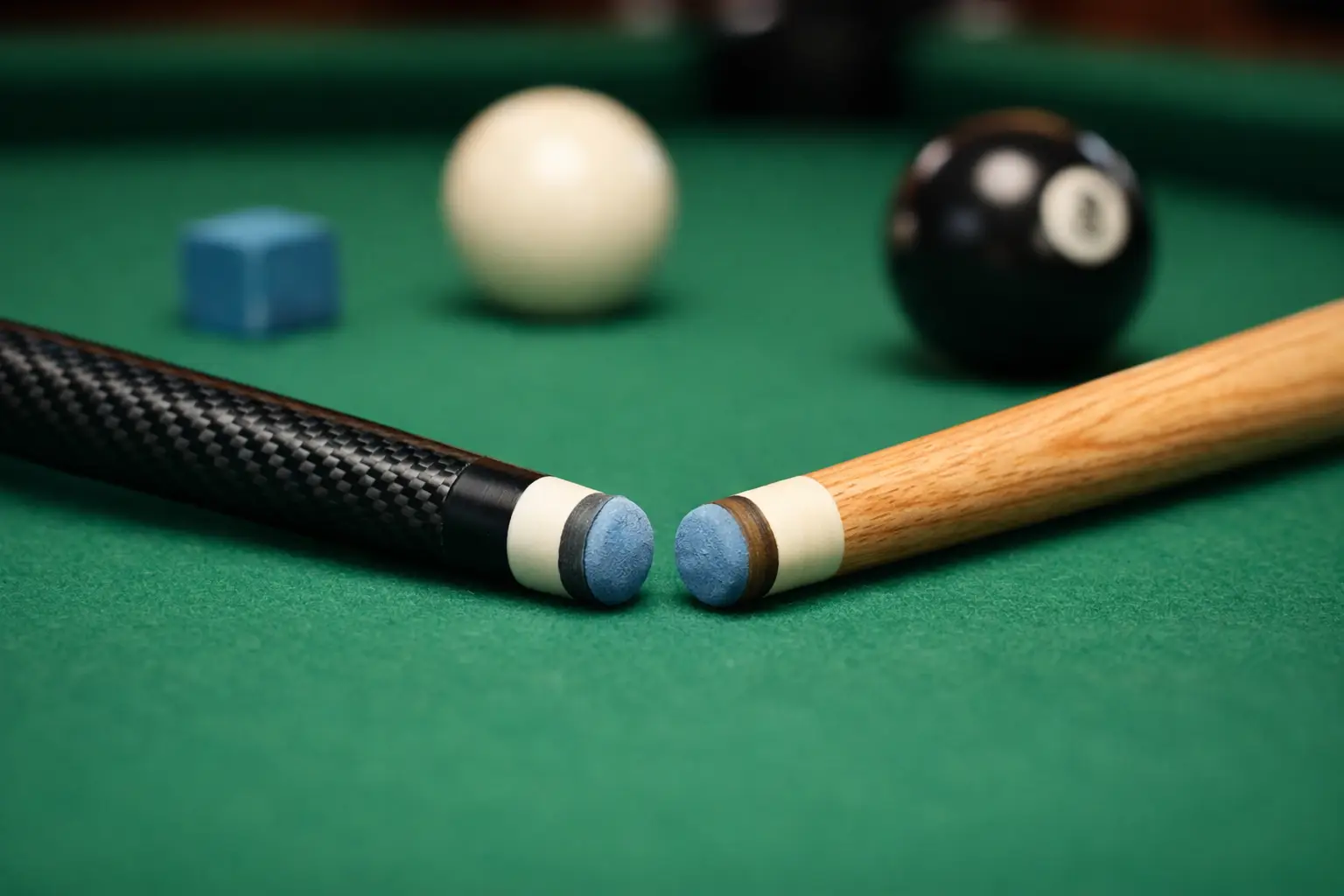
Miss one pressure shot with a soft, weather-sensitive shaft and suddenly the whole carbon cue vs wood cue debate stops being theory. It becomes about confidence, repeatability, and whether your gear holds the line when your stroke has to do the talking. For serious players, this is not an old-school style argument. It is a performance decision.
Carbon cue vs wood cue comes down to consistency
Let’s cut through the nostalgia. Wood cues built the game, and a great maple shaft in the right hands is still dangerous. But carbon changed the conversation because it attacks one of the biggest enemies in cue sports: variation.
Wood is organic. That is part of its charm, and part of its weakness. Grain differs, density differs, and long-term response can shift with climate, storage, use, and maintenance. Some players love that living feel. Others get tired of managing it.
Carbon is engineered for repeatable performance. That matters when you want the same hit on day one, day one hundred, and day one thousand. Less warping risk, less sensitivity to humidity, less fuss. If your priority is a shaft that shows up ready every time, carbon has a real edge.
That does not mean wood is obsolete. It means the question is no longer which material is more traditional. The real question is which material gives you the response your game demands.
Feel is where the fight gets personal
The first thing most players notice is feel. Not specs. Not marketing. Feel.
Wood usually delivers a warmer, more familiar hit. There is often a little more natural feedback through the bridge hand and forearm, especially for players raised on maple. That feedback can help with touch shots, soft spin, and speed control if you are deeply tuned to it.
Carbon usually feels cleaner, sharper, and more direct. The hit can seem stiffer, faster, and more immediate. Some players describe it as more connected. Others call it less forgiving. Both can be true depending on taper, tip, ferrule design, and your stroke.
This is where weaker comparisons fail. A carbon shaft with the wrong tip for your game can feel too rigid. A wood shaft with the wrong taper can feel sluggish. Material matters, but build matters too.
If you play aggressively, like a firm hit, and want a shaft that transfers intent with minimal drama, carbon starts to look like the machine-built answer. If you rely on old-school touch and love a more organic response, wood still has a case.
Feedback is not the same as performance
Some players confuse familiar feedback with better results. That is not always accurate. A wood cue can feel richer in the hand while still producing more variation shot to shot. A carbon cue can feel less romantic while delivering tighter consistency.
The best test is not which shaft feels more alive during warm-up. It is which shaft keeps your cue ball under control when the match gets tight.
Deflection, spin, and cue ball command
This is where performance players stop debating and start measuring.
In general, modern carbon shafts are built to reduce deflection and increase predictability, especially on off-center hits. That gives many players a simpler aiming adjustment when applying english. Less compensation can mean faster adaptation and more confidence under pressure.
Wood shafts vary more. Some traditional maple shafts deflect noticeably more than low-deflection carbon options. Some laminated or specialized wood shafts close the gap. So this is not a carbon landslide across every product in existence. But as a category, carbon has pushed shaft performance forward in a big way.
For players who use lots of sidespin, power draw, or forceful cue ball routes, carbon often feels like the more precise weapon. The shaft stays stable, the response stays clean, and miscues from small inconsistencies can become less common once you adjust.
That said, lower deflection is not magic. If your timing is off, your timing is off. Carbon does not fix mechanics. What it can do is remove some equipment noise so your actual stroke becomes easier to trust.
Carbon wins the durability battle
This section is not close.
Wood needs care. It can absorb moisture, pick up grime, change texture, and in bad conditions it can warp. Good maintenance helps, but maintenance is part of the package. If you play often, travel, or compete in changing climates, wood can become one more variable to manage.
Carbon is built for hard use. It resists environmental changes better, stays smoother, and typically needs less day-to-day attention. That is a major advantage for players who want pro-level gear without the constant babysitting.
There is also the cleanliness factor. A quality carbon shaft tends to stay cleaner in the hand and through the stroke. For players who hate that sticky, draggy feel on a shaft deep into a long session, carbon feels like a clear step into the future.
Long-term value changes the math
A wood shaft can cost less up front, and for some players that matters. But if you factor in maintenance, possible replacement, and performance drift over time, carbon starts looking like a stronger long-term investment.
This is especially true for players who practice heavily. If your cue is not a casual purchase but a core piece of competition equipment, durability is not a side benefit. It is part of the performance equation.
Which one helps different types of players?
Beginners are often told to start with wood because it is traditional and less expensive. That advice is not wrong, but it is incomplete. A newer player with serious intent may benefit from starting with carbon if they want consistency from the start and do not want to relearn around shaft changes later.
Intermediate players usually feel the difference fastest. This is the stage where cue ball control gets more ambitious and bad equipment habits get exposed. If you are adding more english, tightening position play, and competing more often, carbon can offer a noticeable upgrade in predictability.
Advanced players split into two camps. One group wants every engineered advantage available and sees carbon as the obvious move. The other group has decades of touch built around wood and values that exact feedback loop more than any material advantage. Neither camp is wrong. But only one is leaning into where cue technology is heading.
For break cues, the argument swings even harder toward carbon because power, stiffness, and stability are premium assets. For playing cues, it depends more on your stroke, preferences, and how much you value low-maintenance precision.
The real trade-offs in carbon cue vs wood cue
Carbon is not automatically better for every player in every moment. It can feel too crisp for players who want a more cushioned hit. It can expose a jabby stroke because the response is so immediate. And some players simply enjoy the tradition and sensory feedback of wood more.
Wood is not automatically outdated either. A high-quality wood shaft can play beautifully, especially for players with refined touch and a deep connection to classic cue feel. It is still capable of elite shot-making.
But trade-offs matter. Choosing wood often means accepting more maintenance, more environmental sensitivity, and usually more variation. Choosing carbon often means accepting a more modern hit profile and paying more upfront for a shaft built to stay in the fight longer.
That is the real divide. Tradition and feel on one side. Stability and engineered consistency on the other.
So which should you buy?
If you want the shortest answer, buy wood for tradition, buy carbon for performance consistency.
If your game is built around touch, you love classic feedback, and you do not mind caring for your gear, a good wood cue can still be the right choice. It has soul, history, and in the right setup, serious playability.
If you want cleaner performance, lower maintenance, strong durability, and a shaft that feels built for modern competition, carbon is hard to ignore. For players chasing measurable advantages instead of sentimental ones, that is usually the stronger move.
That is why more serious players are switching. Not because carbon is trendy. Because it answers real problems that show up in real matches.
A brand like ON CYBORG speaks directly to that shift – precision-first gear, advanced materials, and performance without apology. That mindset fits the modern player who wants equipment that works as hard as they do.
The best cue is the one that makes your decisions feel simpler under pressure. If wood gives you that, trust it. If carbon gives you that, the future is already in your hands.