

Blog
Leather Tip vs Phenolic: Which Wins?

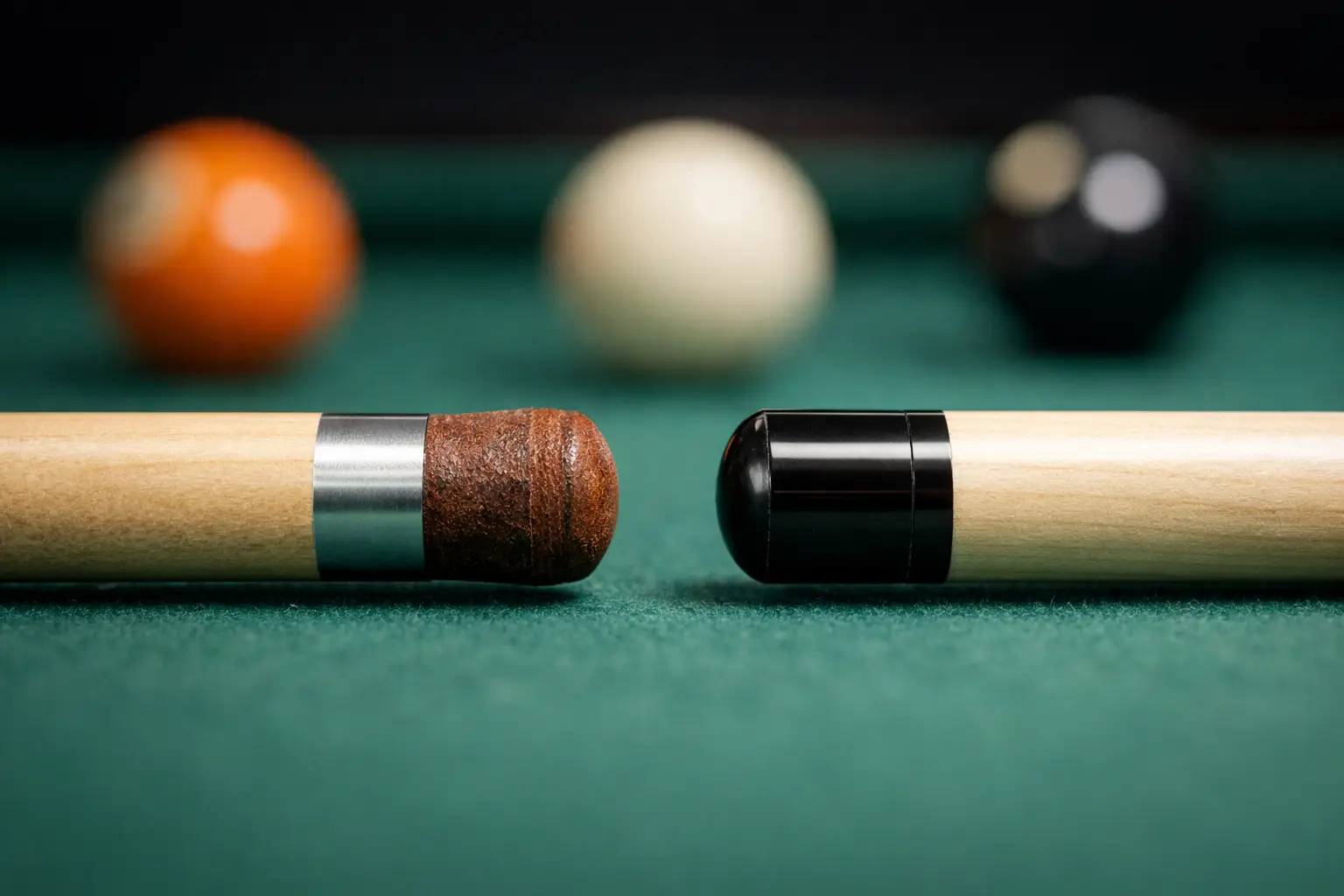
The shot tells the truth fast. If your break explodes but the cue ball flies off the table, or your jump cue launches clean but feels harsh, you are already in the middle of the leather tip vs phenolic debate. This is not a minor gear detail. Tip material changes energy transfer, cue ball control, sound, feel, and how much margin for error you get under pressure.
For serious players, the real question is not which tip is “better” in some abstract sense. It is which tip gives you the exact response your game demands. Leather and phenolic are built for different jobs. Choose wrong, and your cue fights you. Choose right, and the cue starts acting like an extension of intent.
Leather tip vs phenolic: the real difference
Leather is the traditional performance material. It compresses on contact, grips the cue ball better, and gives you more feedback through the hit. That means more spin potential, more touch, and usually more forgiveness on anything that is not a pure power shot. Whether it is a soft single-layer tip or a hard laminated tip, leather lives in the world of control.
Phenolic is a different animal. It is extremely hard, dense, and fast off the cue ball. It barely compresses, so less energy gets lost at impact. That is why it has been a favorite on break and jump cues for years. The hit is sharper. The transfer is more immediate. When your job is to send maximum force into the rack or pop the cue ball up fast, phenolic is built for violence.
That difference in compression is everything. Leather holds the ball for a fraction longer. Phenolic gets in and out instantly. One favors precision. The other favors raw transmission.
Why leather still dominates playing cues
If you are using one cue for actual runout play, leather is still the standard for a reason. Pool is not won on one spectacular break. It is won on the next six, eight, or ten shots, where speed control and spin control matter more than brute force.
A leather tip gives you more confidence when you are moving the cue ball across rails, dragging it into line, or loading up with side spin. You can feel the contact better, and that feedback matters. Better feedback means better adjustment. Better adjustment means fewer guessing strokes.
Hardness matters here too. A soft leather tip can feel lively and grab the cue ball well, but it may mushroom faster and need more maintenance. A medium or hard leather tip tends to hold shape better and gives a more direct hit, which many stronger players prefer. For players chasing a crisp but playable response, hard leather often lands in the sweet spot.
This is why leather remains the all-around weapon. It is versatile. It lets you break decently, play position, spin the rock, and stay legal in rule sets that restrict ultra-hard materials on standard playing cues. It may not hit as brutally as phenolic, but it wins more shots over a long set.
Where phenolic takes over
Phenolic was made for specialized destruction. On a break cue, it is all about efficient energy transfer. Less compression means more of your stroke reaches the cue ball and then the rack. You get a harder hit, a louder report, and often a more explosive spread when your mechanics are solid.
On a jump cue, phenolic makes even more sense. The hard surface helps the cue ball leave the cloth quickly, which is exactly what jump shots demand. You do not need long dwell time for a jump. You need instant reaction. That is why so many jump cues are built around phenolic or other ultra-hard tip materials.
But power without control is just noise. A phenolic break can produce a monster rack spread, yet it can also make the cue ball harder to tame if your contact point is even a little off. Players with loose break mechanics often discover this the hard way. The tip is not forgiving. It amplifies what you bring to the table.
That is the trade-off. Phenolic gives elite force and speed. It gives less touch and less spin flexibility. For specialty cues, that is perfect. For all-around play, it can feel one-dimensional.
Leather tip vs phenolic for breaking
This is where the decision gets more personal. If you want maximum pop and your break stroke is repeatable, phenolic is a serious weapon. It creates a fast, explosive transfer that suits players who break with confidence and want every bit of available power.
If you want a break that still hits hard but gives you more cue ball command, hard leather deserves respect. A good hard leather break tip can still move the rack aggressively while offering a slightly more controlled hit. That matters for players focused on making a ball and parking the cue ball, not just smashing the triangle into orbit.
In other words, phenolic often wins the horsepower battle. Hard leather can win the control battle. For modern competitive play, control off the break is not optional. It is part of the offense.
This is also where shaft construction enters the conversation. Pair a high-performance carbon break shaft with the wrong tip and you can create a hit that feels dead, wild, or overly stiff. Pair it correctly and the cue becomes a launch system. The best setups are not random. They are tuned.
What the hit actually feels like
Players love talking specs, but feel is what makes a cue stay in the case or stay in your hand.
Leather feels more connected. Even on harder versions, there is some give. You sense the hit, the contact, the path of the cue ball. That sensory feedback helps many players trust finesse shots and heavy-spin shots.
Phenolic feels cleaner and more abrupt. The hit is immediate, hard-edged, and loud. Some players love that machine-like response. Others find it too rigid, especially if they are using it outside of break and jump situations.
Neither reaction is wrong. It depends on what your stroke likes and what your game asks for. If you thrive on feel, leather usually wins. If you want uncompromising strike efficiency, phenolic has the edge.
Rules, maintenance, and practical reality
There is also the matter of legality. Some leagues and tournament formats have restrictions on tip materials, especially for jump cues or full-time playing cues. Before you commit to phenolic, check the rules that govern where you actually compete. The hardest-hitting setup in the world is useless if it stays in the bag.
Maintenance is another dividing line. Leather needs shaping, occasional scuffing, and more attention over time. That is the price of a material that grips and compresses. Phenolic is easier to keep consistent because it is so hard and stable. It does not deform like leather. For players who want a low-maintenance specialty tip, that is a real advantage.
Still, low maintenance does not mean universally better. It just means simpler ownership. Serious players should care more about performance fit than convenience.
Which one should you choose?
If your cue is for runout play, choose leather. If your cue is for jumping, choose phenolic. If your cue is for breaking, the answer depends on whether you value maximum force or a more balanced mix of power and cue ball control.
Players with explosive, accurate break mechanics can get huge benefit from phenolic. Players who want a little more feel and a wider margin often prefer hard leather. Advanced players sometimes carry both types for exactly that reason. One tool for violence. One tool for command.
That is the smarter way to think about the leather tip vs phenolic question. Not as a winner-take-all fight, but as a performance decision tied to the job. The best gear does not try to be everything at once. It is engineered for purpose.
A brand like ON CYBORG lives in that performance-first lane – where material choice is not cosmetic, it is tactical. The players who understand that are the ones who build cue setups that actually deliver under pressure.
If you want your cue to hit with intent, stop treating the tip like an afterthought. It is the final contact point, the last command center before impact, and sometimes the difference between a decent shot and a takeover shot.